


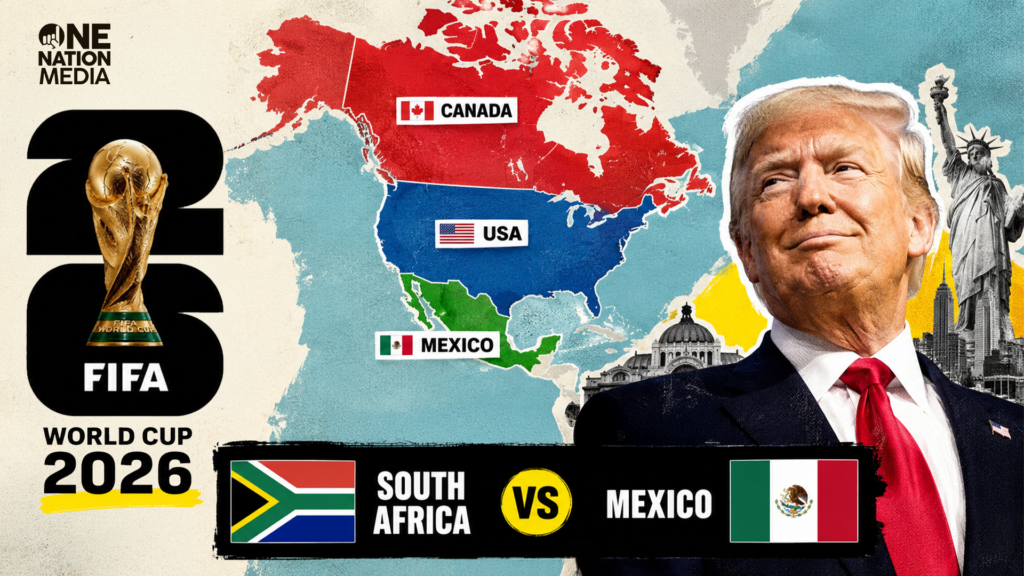
The FIFA World Cup is sold to the world as a celebration of football, unity and human excellence. But beneath the floodlights, fan zones and corporate branding lies something far more political: a global spectacle that channels public emotion, sanitises power and distracts billions from the crises unfolding around them, writes Najm Al-Din.
With an unmatched global audience and a commercial pull that drives multibillion-dollar industries, the FIFA World Cup remains the world’s most anticipated and lucrative sporting event.
As cities around the world turn public squares into fan zones, and schools and businesses adjust schedules around national team fixtures, the competition transcends sport. It alters daily social rhythms and transforms host countries into epicentres of global tourism.

![Top left to right: Uzbekistan team and Senegal player. Bottom left to right: Omar Artan and Aymen Hussein [Images: Anadolu Agency]](https://1nationmedia.com/wp-content/uploads/2026/06/IMG_2663-1024x576.png)
However, this year’s enthusiasm has been dampened. The Trump administration’s aggressive immigration crackdowns and travel restrictions have barred fans and officials from several qualified nations, turning what is supposed to be a global celebration into a hostile environment for many.
Record-high ticket prices, now reportedly under investigation over allegations of price gouging, have also alienated many ordinary fans.
Despite the controversy, the World Cup is still expected to capture untapped markets and generate record-breaking viewership. Yet this massive commercial success also highlights how mega-sporting events function as a modern version of “bread and circuses”, a highly engineered spectacle that distracts the public from systemic political, economic and social crises.
Bread and circuses
The term “bread and circuses” was coined by the Roman satirist Juvenal, who condemned the citizens of ancient Rome for trading their civic duty and political rights for superficial appeasement, including state-sponsored food and lavish entertainment such as gladiatorial games and chariot races.
Juvenal mourned the Roman Republic’s transition into an autocratic empire, lamenting how citizens became indifferent to political tyranny while consumed by immediate gratification. In a world troubled by geopolitical instability, economic inequality and environmental degradation, modern sporting events like the World Cup scale the ancient Roman model in several ways.
Cultural hegemony
For many critical theorists, today’s “bread and circuses” function as a structural mechanism for diversionary politics. Instead of relying on physical coercion alone, ruling classes embed capitalist values such as individualism, materialism and consumerism into civil society institutions, including popular culture. They then use mass-produced entertainment to capture the imagination of the working classes and achieve what Antonio Gramsci described as “cultural hegemony”.
This helps manufacture consent by shaping public desires, interests and consciousness to the point where people are conditioned into accepting the dominant cultural framework as legitimate, natural and unquestioned. In doing so, potential revolutionary energy is defused.
Agenda-setting
According to agenda-setting theory, the media shapes what the public thinks about by prioritising certain topics while disregarding others. By continuously allocating airtime and visibility to specific stories, news outlets signal to audiences which issues are most important and deserving of attention.

The World Cup illustrates this reality. For an entire month, global media ecosystems saturate the public sphere with sporting narratives, patriotic fervour, star players, national flags and high-profile fixtures.
This dramatically boosts the marketability and cultural appeal of teams, players and sponsors.
Ultimately, constant exposure to the carnival crowds out coverage of pressing global issues and monopolises the public’s finite attention span. In this sense, the tournament functions as a powerful tool of distraction.
Sportswashing
The World Cup also carries the hallmarks of sportswashing, a practice in which governments or corporations use high-profile sporting events to distract from political controversies, human rights abuses or policy failures.
With global trust in the U.S. at a historic low, and its democratic reputation damaged by free speech infringements, political polarisation and hawkish foreign policy, hosting a prestigious tournament helps project diplomatic leadership, burnish its global image and deflect criticism from deep-seated political failures. This strategy has historic precedent.
Throughout the 1920s and 1930s, Italian dictator Benito Mussolini weaponised sport to foster nationalism and distract from domestic oppression. By investing in state-of-the-art infrastructure, he sanitised Italy’s international reputation and projected an image of modernity, hospitality and global integration.
Similarly, the 1936 Berlin Olympics helped launder the Nazi regime’s image, masking human rights abuses against minorities while projecting a false image of peace. Under Propaganda Minister Joseph Goebbels, Adolf Hitler temporarily removed antisemitic signage and allowed a Jewish athlete onto the German fencing team. These public relations stunts helped prevent an international boycott and deceived the International Olympic Committee with an illusion of inclusivity. To cement the facade, the regime commissioned filmmaker Leni Riefenstahl to direct a pioneering documentary glorifying Nazi Germany.
Amid international criticism, American ruling elites can use the World Cup to amplify soft power by staging a polished, conflict-free spectacle. The tournament offers an opportunity to craft a public relations counter-narrative that minimises critical coverage, sanitises political friction and masks the global instability Washington is accused of helping create.
Spectacle
Football’s ultimate prize also mirrors French philosopher Guy Debord’s concept of the “society of the spectacle”.
Debord argued that modern capitalism replaces authentic lived experience with representations. Human relations are no longer direct but mediated through a continuous stream of images, mass media and consumer goods.
Building on Marx’s theory of commodity fetishism, Debord argued that the consumer age replaces political agency with a society of illusions. Capitalism, he suggested, had evolved beyond physical production, with its ultimate commodity becoming the “spectacle”: a matrix of mass media, advertising and entertainment that dictates human desire and mediates social relations.
In this light, the World Cup functions as an opiate of the masses. Everything from pristine stadiums to corporate branding presents a flawless, hyperreal utopia. This simulation distances spectators from the material realities that are sanitised to preserve the spectacle’s aesthetic purity. The result is a pseudo-reality that reinforces subservience to an underlying capitalist logic.
Postman
Much of Debord’s critique is echoed in Neil Postman’s Amusing Ourselves to Death, which argues that major cultural events are increasingly transformed into television entertainment that prioritises spectacle over substance, resulting in a descent into triviality.
According to Postman, the shift from print culture to television culture forced public discourse to conform to the shallow demands of show business. Everything from politics to economics is repackaged as bite-sized entertainment, transforming how truth is perceived and replacing rational debate with emotional amusement.
While Debord approached the issue through Marxist critical theory and Postman through media ecology, both reached a similar conclusion: modern culture is pacified and controlled not primarily by physical force, but by a relentless barrage of superficial imagery that reduces citizens to passive consumers for global media corporations and sponsors.
Applied to the FIFA World Cup, these frameworks show how a genuine sporting event can be transformed into a massive commodified spectacle. Flashy opening ceremonies, pop anthems and dramatic pre-match narratives make viewers feel engaged while leaving them politically and socially anaesthetised.
Borrowing a Huxleyan phrase, the World Cup serves as a global “soma”, wrapping the planet in a four-week embrace of amnesia and blissful escape. It placates the masses so effectively that many fail to notice the chains binding them.
This hedonistic diversion functions as a powerful form of pleasurable servitude and controlled catharsis. Mirroring the social control mechanisms of Brave New World, the tournament provides a state-sanctioned outlet for intense human emotions such as anger, joy and tribalism. It arouses collective solidarity while preventing those emotions from being directed against governing systems.
Islam
Islam encourages physical fitness and permissible recreation as part of a balanced and holistic lifestyle. However, it also warns against the human tendency to surrender critical awareness to comforting distractions.
Islam does not condemn sport or recreation in itself. But when casual fandom becomes fanaticism, and excessive zeal consumes a Muslim’s time, energy and resources at the expense of faith-based obligations, it becomes spiritually dangerous and religiously blameworthy.

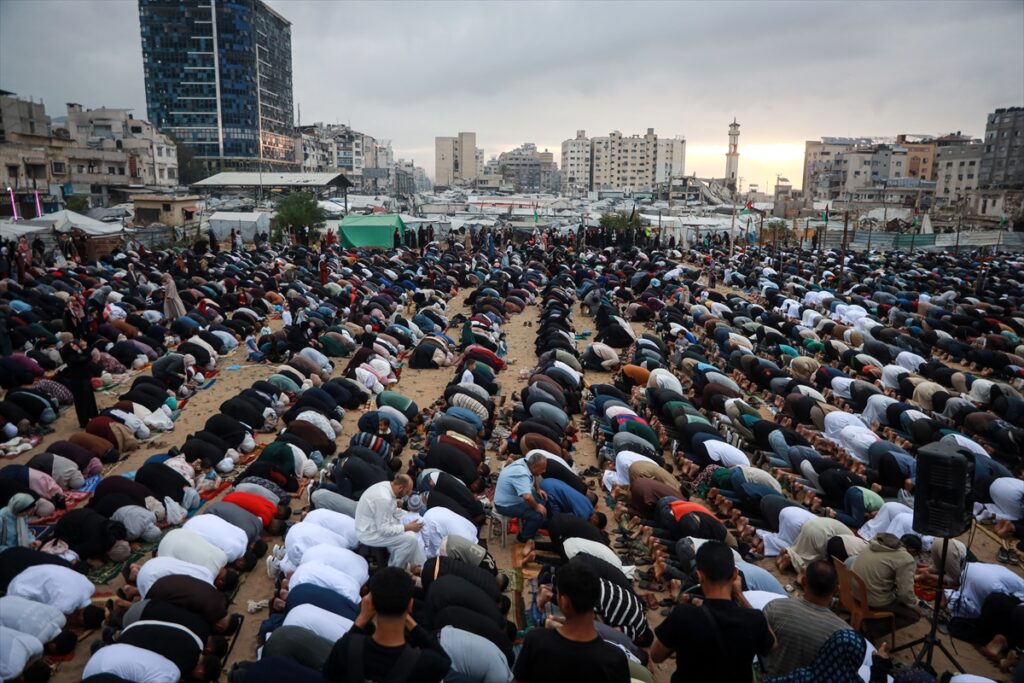
Time is among the believer’s most valuable assets. It should not be squandered by allowing excitement over the World Cup to descend into laghw, idle and unbeneficial distraction that diverts us from our purpose in life: the worship of Allah.
The synthetic layer of noise generated through post-match debates, ecstatic celebrations and endless media analysis can easily leave Muslims in a state of ghaflah, or heedlessness. It can drown out the remembrance of God and desensitise believers to the suffering of fellow Muslims.
At a time when aggression against Muslim lands, ongoing incursions at Masjid Al-Aqsa and the rising tide of Islamophobia continue unabated, allowing the World Cup to hijack our emotions through blind tribalism and misplaced passion for national teams would be a serious dereliction of Islamic duty.
Conclusion
By replacing critical civic engagement with emotional investment in a transient game, the architects of mega-sporting events have successfully executed a modern form of bread and circuses.
The collective euphoria of the tournament provides the global public with temporary escape from worldly concerns, shielding them from coherent engagement with reality. Yet the foundational crises of global capitalism remain unchallenged. Instead, much of the population continues to resemble the socially engineered and docile citizens of the Capitol in The Hunger Games.
For the Ummah, indulging in this spectacle demands constant vigilance. Passion for the game must never numb our critical faculties or distract us from the ongoing assault against Muslims and humanity at large.
True victory does not lie on the pitch. It lies in resisting the sensory anaesthetic of the spectacle.