


Along the sweeping bend of the Niger River, the Songhai Empire rose to become one of the greatest powers in African and Islamic history, writes Neelam Rahim.
Emerging from the decline of the Mali Empire, Songhai expanded across West Africa through military strength, control of trade routes and command over the great Sahelian cities of Gao, Timbuktu and Djenné.
At its height in the 15th and 16th centuries, the empire governed vast territories across parts of modern-day Mali, Niger and surrounding regions. It linked West Africa to North Africa, the Mediterranean and the wider Muslim world through trans-Saharan trade, Islamic scholarship and political diplomacy.
Long before European colonialism, Songhai stood as a powerful example of African statecraft, urban civilisation and intellectual life. Its rulers controlled gold and salt routes, maintained disciplined armies, governed through provincial administration and supported centres of learning that attracted scholars from across the Islamic world.
Its power was built on wealth, law, trade, military organisation and Islamic scholarship. Its legacy remains one of the clearest answers to the false colonial claim that Africa lacked civilisation before European conquest.
Origins along the Niger River
The Songhai state developed from the Songhai people based around Gao, a major city on the banks of the Niger River.
Gao had long been a vital commercial centre, positioned near the crossroads of trade routes linking West Africa to North Africa and beyond. This gave early Songhai rulers access to taxation, commerce and political influence.
During the decline of the Mali Empire in the 15th century, Songhai leaders asserted greater independence and began expanding their influence over surrounding territories. This marked the beginning of a new imperial phase that would soon eclipse Mali in military strength, political organisation and territorial reach.
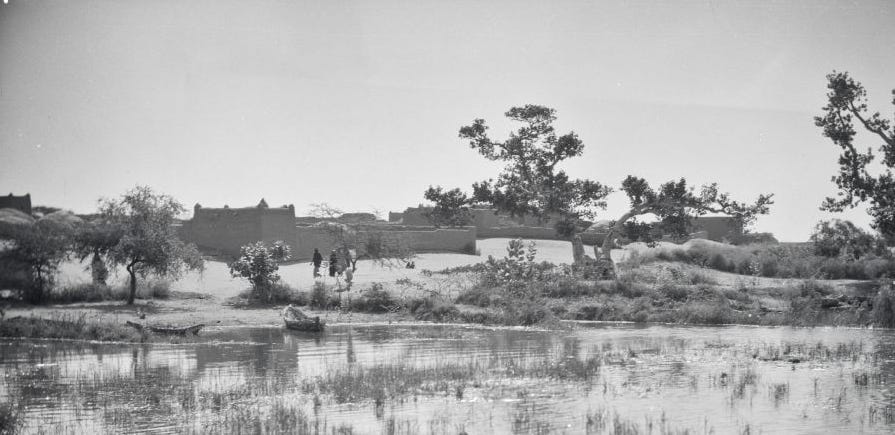
The Niger River was central to this rise. It was not only a source of food, transport and agriculture, but also a strategic artery that connected cities, markets and military positions across the region.
Sunni Ali and military expansion
A major turning point came under Sunni Ali, also known as Ali Ber, who ruled from 1464 to 1492. He is widely regarded as the ruler who transformed Songhai into a dominant military empire. Sunni Ali built a powerful army that combined cavalry forces with a river fleet operating along the Niger, allowing him to control both land and water routes.
His campaigns dramatically expanded Songhai territory and brought major cities such as Timbuktu and Djenné under imperial control. These cities were not only centres of trade but also key symbols of religious and intellectual prestige.
Timbuktu, already famous for commerce and Islamic scholarship, became a strategic prize within the empire. Djenné, with its commercial strength and Islamic identity, further strengthened Songhai’s position across the Sahel.
Sunni Ali’s reign, however, was marked by religious complexity. Islam was already influential in urban centres, particularly among scholars, merchants and administrators, but Sunni Ali was often viewed as maintaining strong links to indigenous religious practices. This created tension with Muslim scholars, whose influence was growing across the region. Despite those tensions, his rule laid the military and territorial foundations for Songhai’s imperial greatness.
Askia Muhammad and Islamic reform
After Sunni Ali’s death, Askia Muhammad, also known as “Askia the Great”, took power in 1493 following a political struggle. His reign marked one of the most important transformations in Songhai history. While Sunni Ali built the empire through conquest, Askia Muhammad gave it a more formal Islamic and administrative structure.

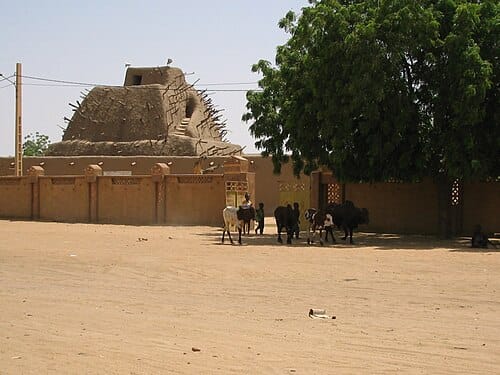
Askia Muhammad openly embraced Islam and made it central to the identity and governance of the empire. He reorganised Songhai into provinces governed by appointed officials, improved taxation systems, strengthened central authority and brought scholars into public life.
Islamic law, scholarship and religious authority became more closely connected to the state. Muslim judges, jurists and scholars played an important role in advising rulers, resolving disputes and shaping public administration.
One of the defining moments of Askia Muhammad’s reign was his pilgrimage to Makkah. The journey connected Songhai more deeply with the wider Muslim world and strengthened its diplomatic and religious ties with North Africa and the Middle East.
Through his Hajj, Askia Muhammad enhanced his legitimacy as a Muslim ruler and returned with ideas that influenced governance, scholarship and religious practice in his empire.
Under his leadership, Songhai reached its greatest territorial extent and became one of the largest empires in African history. It was not a remote or isolated state, but a major Muslim power connected to global trade, scholarship and diplomacy.
Islam, learning and urban civilisation
Islam played a major role in shaping Songhai’s intellectual, legal and cultural life, particularly in its urban centres.
Cities such as Gao, Timbuktu and Djenné became hubs of scholarship, commerce and religious learning. They attracted jurists, theologians, teachers, astronomers, merchants and students from across West Africa and the wider Islamic world.
Timbuktu became especially famous for its libraries, manuscript culture and centres of Islamic education. Scholars studied and copied works on Qur’anic sciences, theology, law, mathematics, astronomy, grammar and history.

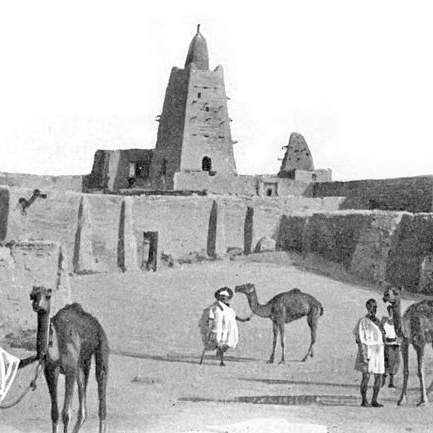
The city’s reputation was built not only on wealth, but on knowledge. It became one of the great symbols of Islamic learning in Africa and a reminder that the continent was deeply connected to global intellectual traditions.
Islamic education was closely linked to governance. Scholars advised rulers, interpreted law and helped shape the moral and administrative life of the empire. The written manuscript tradition also preserved knowledge across generations, making Timbuktu and other cities key centres of African Islamic heritage.
However, the spread of Islam was not uniform. While it strongly influenced elite, urban and scholarly life, many rural communities continued to practise indigenous religious traditions. Songhai society therefore reflected a layered reality in which Islamic and traditional practices coexisted across different regions and communities.
Trade, wealth and administration
Songhai’s economic strength came from its control of trans-Saharan trade routes. Gold from the forest regions of West Africa and salt from the Sahara formed the backbone of its wealth. Kola nuts, textiles and other goods also moved through its markets, while trade connected the empire to North Africa and beyond.
Control of trade allowed Songhai’s rulers to fund the army, maintain cities, support administration and strengthen political authority.
To govern its vast territory, the empire developed a structured administrative system. Provinces were placed under appointed officials who reported to the emperor, helping maintain control over distant regions.
Taxation from trade and agriculture funded the state and reinforced its power. The military, including cavalry forces and a naval fleet on the Niger River, allowed rapid movement of troops and protection of key trade routes.
This combination of wealth, military strength and administration made Songhai one of the most sophisticated polities of its time.
Decline and fall
After Askia Muhammad’s reign, the empire began to weaken through internal succession disputes and political fragmentation. Rival factions competed for power, central authority weakened and the empire became increasingly vulnerable to external attack.
In 1591, the Saadi dynasty of Morocco launched a military invasion across the Sahara. Moroccan forces, armed with firearms and artillery, defeated Songhai at the Battle of Tondibi. The defeat marked the collapse of Songhai’s imperial authority and led to the fragmentation of the empire into smaller polities.
While the Moroccan invasion was decisive, Songhai’s fall was also the result of internal weakness, succession struggles and declining administrative unity.
Despite its collapse, the Songhai Empire left a lasting legacy in West African and Islamic history. Its administrative systems influenced later states, its trade networks continued to shape regional economies and its centres of Islamic learning became part of the wider intellectual heritage of the Muslim world.
Songhai showed that pre-colonial Africa produced powerful states with complex governance, military organisation, global trade links and deep scholarly traditions.
Its history challenges the colonial myth that Africa was backward or disconnected before European conquest. Along the Niger River, Songhai built one of the great civilisations of the medieval world, rooted in African political power, Islamic learning and transcontinental exchange.
For African Muslims today, the Songhai Empire remains a reminder that the continent’s history is not one of absence, but of power, knowledge, faith and civilisation.
You can read more of One Nation Media’s Islamic civilisation and African history features here.