


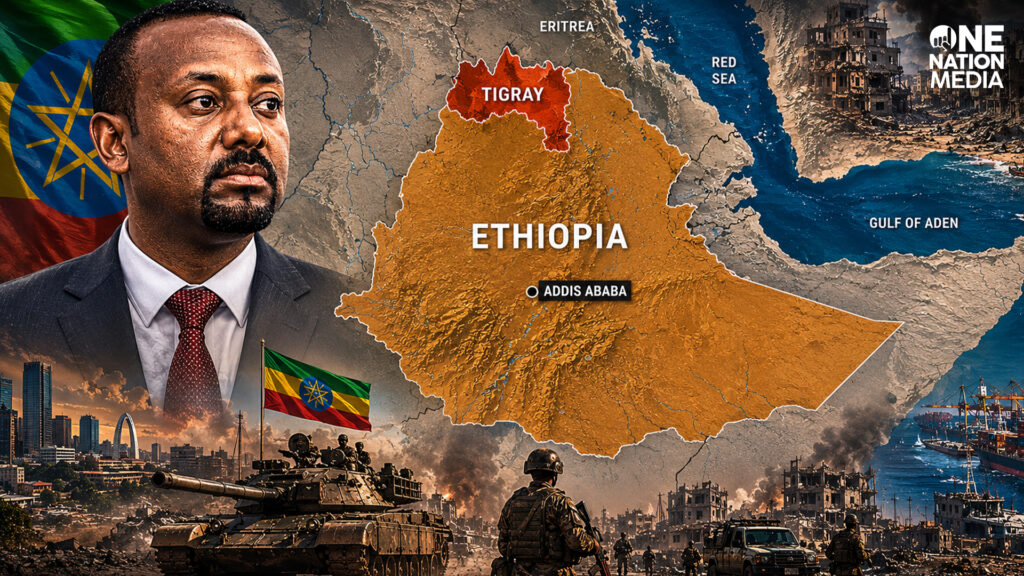
Ethiopia heads to the polls at a moment of deep regional uncertainty, with unresolved tensions from the Tigray war, growing mistrust with Eritrea, and escalating disputes over the Nile and Red Sea access threatening to reshape the balance of power across the Horn of Africa.
Prime Minister Abiy Ahmed’s government has sought to project an image of stability and economic recovery since the end of the devastating civil war in 2022. But beneath the surface, Ethiopia remains burdened by unresolved political, ethnic and security fault lines.
The vote comes at a particularly sensitive moment. A recent BBC report highlighted renewed instability in Tigray, where divisions within the region’s political leadership have raised fears that the fragile peace established after the two-year conflict could begin to unravel.
The war claimed hundreds of thousands of lives and displaced millions, leaving deep scars across northern Ethiopia. Entire communities continue to live with the social and economic devastation left behind by the conflict, while distrust between former allies and rivals remains deeply entrenched.
Tigray’s unfinished crisis
Although large-scale fighting has largely ceased, Tigray remains politically fractured. Rival factions within the former ruling Tigray People’s Liberation Front have been locked in a bitter power struggle, while disagreements over the implementation of the Pretoria peace agreement continue to simmer.
The instability has renewed fears that the Horn of Africa could once again be pulled towards conflict, particularly given neighbouring Eritrea’s role in the war. Eritrean forces fought alongside Ethiopian federal troops during the conflict and were accused by rights groups of committing widespread abuses, allegations Asmara has consistently denied.
Relations between Addis Ababa and Asmara now appear increasingly strained. Analysts warn that mistrust between the two governments, combined with instability in Tigray, has created conditions in which any miscalculation could trigger a wider regional confrontation.
The Nile and the Red Sea
Beyond internal security concerns, Ethiopia is grappling with two major geopolitical questions: access to water and access to the sea.
The first centres on the Grand Ethiopian Renaissance Dam (GERD), Africa’s largest hydroelectric project. For Ethiopia, the dam is essential to economic development and energy security. For Egypt, which relies heavily on Nile waters, it remains an issue of national survival.
Negotiations between Ethiopia, Egypt and Sudan have repeatedly stalled, with disagreements over how the dam should be managed during droughts and periods of low water flow. The deadlock has turned the GERD into one of Africa’s most contentious diplomatic disputes.
The second challenge stems from Ethiopia’s status as the world’s most populous landlocked country. Since Eritrea’s independence in 1993, Ethiopia has lacked direct access to the Red Sea and remains heavily dependent on Djibouti for trade.
Abiy’s government has increasingly argued that securing maritime access is an economic necessity. However, Ethiopia’s recent efforts to pursue port agreements in the region have alarmed neighbours, particularly Eritrea and Somalia, who view such moves as potentially destabilising.
Control over trade corridors and maritime access has become one of the defining geopolitical contests in the modern Horn of Africa, especially as global and regional powers expand their military, political and commercial presence along the Red Sea corridor.
Ethiopia’s future is also being watched closely by Egypt, Sudan, Eritrea, Somalia and Djibouti, as well as Gulf states, Turkey, China and Western powers, all of whom have strategic interests in one of the world’s most important trade routes.
Islam’s enduring place in Ethiopia
Ethiopia’s political future is also being watched closely by its diverse religious communities, including one of Africa’s largest Muslim populations.
While Ethiopia is often associated internationally with its ancient Orthodox Christian heritage, Islam remains deeply woven into the country’s identity and history.
Islam’s roots in Ethiopia stretch back to the earliest days of the religion itself, when the Kingdom of Aksum offered sanctuary to persecuted Muslims fleeing Makkah during the First Hijrah. It remains one of the most significant moments in early Islamic history.
Today, Muslims make up roughly one-third of Ethiopia’s population. From the historic city of Harar to the Somali and Afar regions, Muslim communities continue to play an important role in Ethiopia’s cultural, political and economic life.
At the same time, debates around representation, religious autonomy and political inclusion remain part of Ethiopia’s broader national conversation as the country grapples with questions of identity, federalism and national unity.
Ethiopia’s future
As Ethiopians head to the polls, the election is unfolding against a backdrop of unresolved conflict, geopolitical rivalry and competing visions of the country’s future.
The outcome could influence how Ethiopia navigates its relationship with Eritrea, manages tensions over the Nile, and responds to growing competition across the Red Sea region.
For Ethiopia, the election comes at a time when the country is facing fundamental questions about national unity, regional influence and its role within a rapidly shifting Horn of Africa.
With more than 120 million people, control over the Nile’s headwaters and growing ambitions on the Red Sea, Ethiopia remains one of Africa’s most consequential states.
Whether the vote reinforces stability or exposes deeper systemic fractures, it will have implications far beyond Addis Ababa, shaping the future of the Horn of Africa for years to come.