


Long before colonial borders carved Africa into modern states, Fulani pastoralists, traders and Islamic scholars moved across the Sahel carrying cattle, commerce and Qur’anic learning from the Atlantic coast deep into the African interior, writes Neelam Rahim.
Today, the Fulani remain one of Africa’s largest and most widely dispersed Muslim peoples. Known variously as the Fulbe, Fula or Peul, they are spread across a vast belt stretching from Senegal and Guinea in the west to Cameroon, Chad and Sudan in the east. Nigeria is believed to host the world’s largest Fulani population.
Historians generally trace Fulani origins to the Senegambia region and the southern fringes of the Sahara. From there, waves of migration gradually spread eastward and southward over several centuries, shaped by trans-Sahelian trade routes, access to pasture, Islamic expansion and shifting political conditions across West Africa.
By the fifteenth and sixteenth centuries, Fulani communities had become deeply embedded across much of the western and central Sahel. Their migrations helped establish religious, commercial and cultural networks linking distant regions of Africa long before the emergence of modern nation states.
Predominantly Muslim, the Fulani have historically been associated with cattle herding and pastoral life. For generations, nomadic Fulani communities travelled seasonally with livestock in search of grazing land and water, forming one of Africa’s largest pastoral networks. Cattle became central not only to economic survival, but also to social status, marriage customs and communal identity.

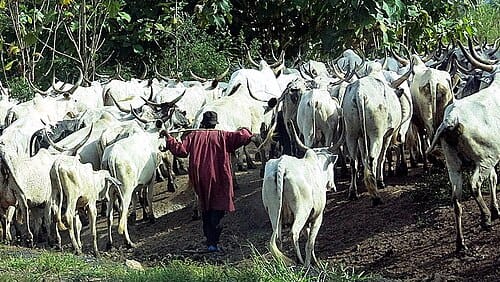
[Image credits: Wikimedia Commons]
Yet the Fulani were never solely nomadic herders. Over centuries, many communities settled permanently and became farmers, merchants, scholars, rulers and urban populations integrated into the political and economic life of West Africa. Today, significant Fulani communities exist across Senegal, Guinea, Mali, Burkina Faso, Niger, Nigeria, Cameroon, Chad and Mauritania.
Despite their geographical spread, many retain strong cultural ties through religion, shared traditions and language. Fulfulde remains one of the most widely spoken indigenous languages in Africa.
Fulani Islamic heritage
Islam has long stood at the centre of Fulani identity. From the medieval period onward, Fulani scholars played a major role in spreading Islamic learning throughout West Africa. Qur’anic education, jurisprudence and scholarship became deeply rooted within many Fulani societies, helping shape the religious landscape of the Sahel for centuries.
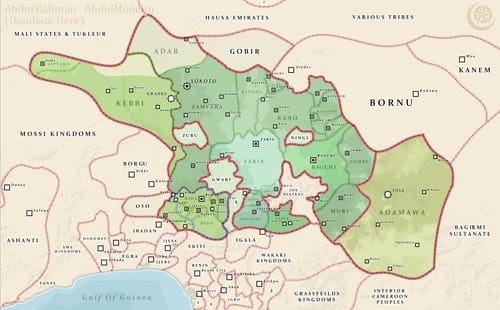
Among the most influential Fulani Muslims in history was Usman dan Fodio, the eighteenth-century Islamic scholar, teacher and reformer who established the Sokoto Caliphate in present-day northern Nigeria. Beginning in 1804, his reform movement challenged corruption, unjust rule and declining religious standards among regional elites. Within a few years, the Sokoto Caliphate emerged as one of the largest and most influential Islamic states in nineteenth-century Africa.
The Sokoto Caliphate became not only a political power, but also a major centre of Islamic scholarship and intellectual revival. Usman dan Fodio promoted literacy, religious education and scholarly exchange across the region. His writings in Arabic and Fulfulde circulated widely and continue to be studied today.
Equally significant was his daughter, Nana Asma’u, one of the most respected Muslim female scholars in African history. A poet, educator and intellectual, Nana Asma’u wrote extensively on Islam, ethics and social reform. Fluent in Arabic, Hausa and Fulfulde, she established educational networks for women that expanded Islamic literacy throughout the Sokoto Caliphate. Her legacy continues to inspire Muslim educators and scholars across West Africa today.
Despite this rich intellectual and religious heritage, modern discussions surrounding the Fulani are often dominated by conflict and insecurity across parts of the Sahel and West Africa.
Climate change pressures
One of the major drivers of these tensions has been environmental pressure. Climate change, desertification and shrinking grazing land have increasingly pushed some pastoral communities further south in search of water and pasture. Drought conditions and changing rainfall patterns across the Sahel have reduced access to traditional grazing routes used for generations.
As herders move southward, competition over land and resources has intensified between pastoralists and settled farming communities in countries such as Nigeria and Mali. Disputes over grazing access, crop destruction, cattle theft and water resources have in some areas escalated into deadly violence.
Analysts caution, however, against reducing these conflicts to simplistic ethnic or religious explanations. Weak governance, criminal networks, arms trafficking, political instability and poverty all contribute to insecurity across the Sahel.
At the same time, many Fulani communities argue they are frequently stereotyped or collectively blamed for violence carried out by armed groups operating in the region. In some areas, Fulani civilians have themselves faced attacks, displacement and reprisals.
In modern political discourse, hostile narratives sometimes portray the Fulani as outsiders or foreign Muslim settlers, despite their centuries-long historical development within West Africa itself. Historians and anthropologists reject simplistic racial characterisations of the Fulani and instead emphasise the complex West African identity shaped through centuries of interaction across the Sahel and Sahara.
The Fulani themselves remain highly diverse. Some communities continue fully nomadic lifestyles, while others are semi-settled, urbanised or integrated into national political and economic systems. Millions now live in towns and cities working as professionals, traders, civil servants, religious scholars and political leaders. There is no single political authority or social structure representing all Fulani people across Africa.
What remains undeniable, however, is the scale of Fulani influence on African history. Through pastoral networks, trade, scholarship and state-building, the Fulani helped shape large parts of West Africa over centuries.
Across generations of migration, learning and religious reform, they became among the most important carriers of Islamic civilisation in the Sahel. Their history extends far beyond the conflicts dominating contemporary headlines, reaching into the deeper story of how faith, mobility and scholarship shaped Muslim Africa.
You can read more of One Nation Media’s Islamic civilisation and African history features here.