


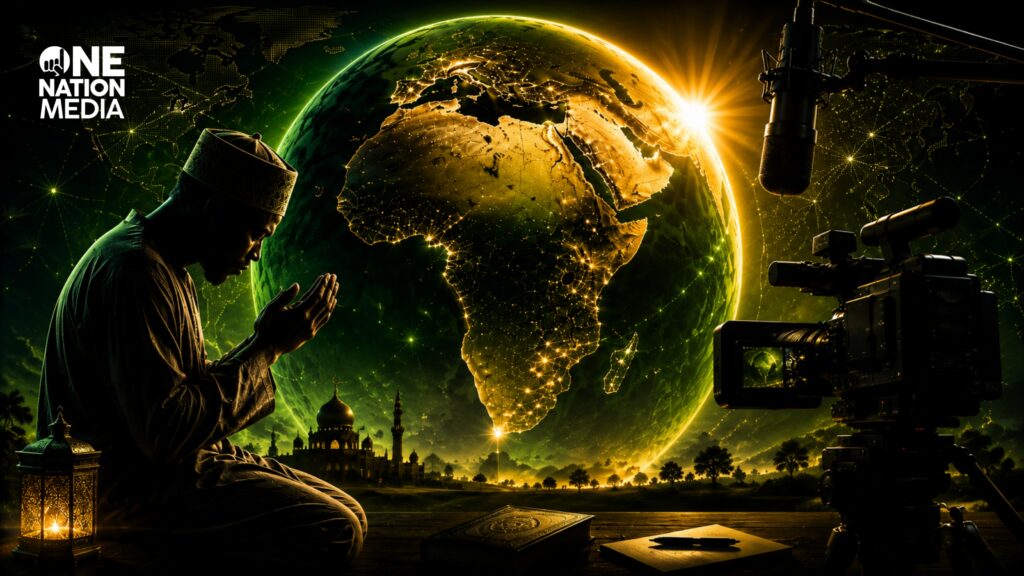
For decades, Muslim media has focused on reminders, outrage and fundraising, while neglecting the far harder task of building the intellectual and developmental infrastructure of a civilisation, writes Teslim Adeyemo.
Imagine a 22-year-old Muslim in Kano, Lagos or Dakar. He prays five times a day. He fasts Ramadan. He attends Jumu’ah. He scrolls through social media: another fundraising appeal, another sermon clip, another story framing Muslims as victims of someone else’s foreign policy. He absorbs all of it, closes the app, and returns to a city weighed down by structural problems — unemployment, broken infrastructure, land disputes and generational trauma — for which his media diet has offered no framework whatsoever.
His iman is intact, but his development imagination is empty. That gap, between deep religious conviction and the practical capability to act upon it, is the media curriculum crisis Muslims are facing.
Beyond reminders and fundraising
A curriculum is a deliberate sequence of knowledge, stories and frameworks designed to develop a person’s capabilities over time. Every serious civilisation has one. Colonial powers understood this well. They built schools, newspapers and broadcast networks not merely to inform, but to construct a particular type of mind: one that viewed the world through their categories, aspired to their models of success, and reproduced their values without being explicitly instructed to do so.
Muslim media, almost without exception, has never truly thought in these terms. It informs. It reminds. It fundraises. It preaches to the converted. But it does not systematically build capacity.
The Quranic objective of da’wah (conveying and inviting to Islam) runs deeper than conversion statistics. It is the establishment of justice, accountability and protection for the vulnerable within the collective consciousness of society, until those values become embedded in how communities build economies, resolve disputes and care for the weak, whether or not anyone explicitly labels it “Islamic”. That is a curriculum objective.
The Prophet (SAW) did not simply speak to those ready to utter the shahada. He built institutions, negotiated treaties, established economic norms, and shaped the moral imagination of an entire civilisation. Preachers speak to the convinced. Curriculum builders shape societies. The distance between those two approaches is the entire argument.
Curriculum as journalism
So, what does such a curriculum look like in practice?
It is not another scholar panel or Quranic recitation series. It is the story of a waqf endowment rebuilding a fishing community’s cold-storage infrastructure after a climate disaster, told with the same seriousness and analytical rigour a Bloomberg journalist would apply to a private equity deal. It is the psychological journey of a young African Muslim healing from colonial trauma through Islamic frameworks of identity and purpose. It is a shura-based governance council in the Sahel resolving land disputes beyond the reach of secular courts, presented as a governance case study. It is the overlooked scholar with profound insight being discovered, profiled and platformed properly.
None of these stories necessarily announce themselves as “Islamic content”. Yet all of them perform Islamic work. This is curriculum as journalism.

The people who most need this curriculum are often those least likely to engage with overtly Islamic media. Development journalism grounded in maqasid al-shariah — the protection of life, intellect, lineage, wealth and faith — but presented as rigorous social analysis can reach audiences that conventional preaching cannot.
A media company with no explicitly Islamic branding, but guided entirely by Islamic editorial logic, can cultivate Islamic consciousness in readers who would switch off the moment a shaykh appears on screen. The Quran commands Muslims to stand up for the weak among men, women and children who have no protector (Qur’an 4:75). That is an editorial mandate, and it requires no label to execute.
Building the infrastructure
African Muslim communities already possess the raw material for this curriculum infrastructure: scholars without platforms, journalists with talent but no institutional home, and a diaspora across Europe and North America with capital, media expertise and global distribution reach.
What is missing is the waqf structure capable of holding it all together. Not one Muslim media outlet, but many — some openly Islamic, others functioning as development media rooted in Islamic values — funded through diaspora remittances channelled into media endowments that train journalists across print, broadcast and digital platforms.
The diaspora has underestimated the significance of this investment. Remittances are regularly sent home for school fees and construction projects, but far less is invested in institutions that shape consciousness itself. That reality must change.
A civilisation teaching itself how to think
The dunya is not a distraction from faith. It is faith’s primary field of application — the ground upon which the curriculum either takes root or withers. Every day African Muslims surrender the infrastructure of narrative to others, and those others fill the vacuum with frameworks that serve their own geopolitical, commercial and ideological interests.
Colonial powers built their curriculum over centuries. Muslim communities are not starting from nothing. We are beginning with an extraordinary inheritance of values, institutions and lived experiences.
What is needed now is the media infrastructure capable of transmitting that inheritance deliberately, consistently and at scale. One outlet is a voice. A distributed ecosystem of trained, waqf-funded curriculum builders operating across the continent is a civilisation teaching itself how to think.
Teslim Adeyemo is a development strategist and the founder of UmmahBuilders, a platform equipping Muslim community leaders with practical frameworks for institutional development and local governance. A former Director of Digital Media at the Dawah Institute, he holds a Master’s in International Affairs and Diplomacy with a specialisation in International Development. His work sits at the intersection of Islamic ethics, media strategy, and community development across Africa and the diaspora. He writes and consults on building Muslim institutions that translate faith into civilisational action. You can follow Teslime on LinkedIn and his Substack.