


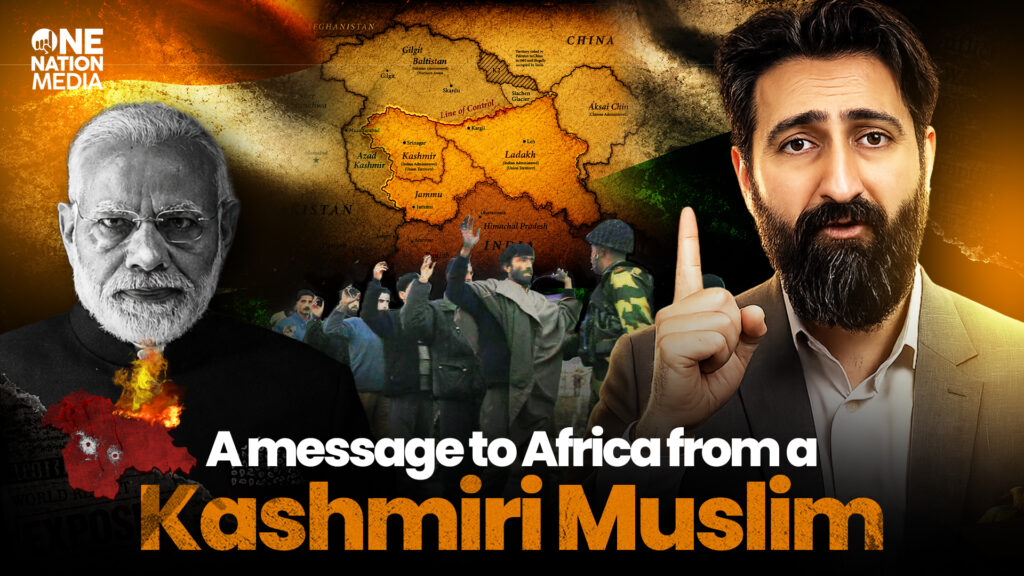
Kashmiri Muslims are the indigenous Muslim population of the Kashmir Valley, comprising more than 97% of the region’s population. Predominantly Sunni Muslim, they descend from local communities who embraced Islam over centuries through the influence of Sufi scholars and Islamic spiritual traditions that remain deeply rooted in Kashmiri society. Today, they live under Indian occupation in one of the most militarised regions in the world, with their homeland controlled by a nuclear-armed India.
For centuries, Kashmir existed as a distinct Himalayan region renowned for its scholarship, culture and strategic position linking Central Asia, South Asia and the wider Muslim world. Prior to 1947, Kashmir functioned as a princely state under British colonial rule, governed by a Hindu monarch despite its overwhelmingly Muslim population. The modern crisis emerged during the partition of British India, when colonial withdrawal fractured the subcontinent and left the future of Muslim-majority Kashmir vulnerable to external political and military control.
In October 1947, following unrest and the advance of tribal fighters from Pakistan’s northwest frontier, Maharaja Hari Singh signed the Instrument of Accession to India in exchange for military assistance. India subsequently deployed troops into the region, triggering the first war between India and Pakistan and laying the foundations for decades of occupation, conflict and instability. A United Nations-brokered ceasefire later divided Kashmir into territories administered by India and Pakistan, while China would later assume control of a separate eastern region.

The situation escalated dramatically in 1989 with the emergence of armed resistance against Indian rule in occupied Kashmir. Many Kashmiris supported the uprising, viewing it as a struggle against foreign occupation and for self-determination. What followed was decades of insurgency, counterinsurgency operations and mass militarisation, transforming the valley into one of the most heavily militarised zones on earth.
Over the decades, Indian-occupied Kashmir has been marked by widespread extrajudicial killings, enforced disappearances, torture, sexual violence, arbitrary detentions and severe restrictions on civil liberties. Daily life for ordinary Kashmiris has long been shaped by military checkpoints, surveillance, curfews, communications blackouts and recurring crackdowns by Indian security forces.
For many Kashmiri Muslims, the issue is not a mere territorial disagreement between rival nuclear states, but a struggle against occupation, political disenfranchisement and the suppression of their Islamic identity and right to self-determination. More than seven decades after the end of British colonial rule, Kashmir remains one of the clearest examples of how colonial borders, post-colonial power politics and military occupation continue to shape the lives of Muslims across the subcontinent.