
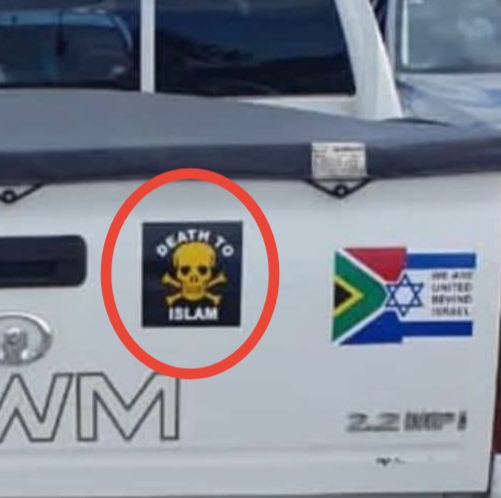
Seemingly isolated incidents of Islamophobia in South Africa may point to a far broader and more deliberate effort to shape public perception
Speaking to One Nation Media, Moulana Ebrahim Moosa, Researcher at the Palestine Information Network, warned against dismissing inflammatory symbols, online rhetoric, and public demonstrations as insignificant.
“I think one can easily dismiss this as something marginal or fringe,” he said, referring to stickers, social media posts, and small pro-Israel gatherings. However, he urged a shift in perspective, arguing that society should “look at the bigger picture and actually realise that there could be something bigger at play,” adding that communities should remain “cognisant” and “vigilant” in recognising warning signs.
In a recent incident that adds to the unease, a bakkie spotted in Cape Town was seen carrying stickers reading “death to Islam” – a message that is difficult to dismiss as insignificant. The image, shared by a mayoral candidate, has since circulated online, raising questions about how such openly hostile messaging is appearing in everyday public spaces, and what it may signal in the broader context.
ML Moosa pointed to what he described as three key factors underpinning these concerns. The first is a significant increase in Israel’s global messaging budget.
“The Israelis have greatly expanded their Hasbara budget,” he said, noting that billions have been allocated to “public diplomacy and overseas influence operations.”
Secondly, he identified South Africa as a likely focal point for such efforts. According to ML Moosa, the country’s stance on Israel, particularly “its championing of the genocide case at the ICJ,” has placed it firmly in the spotlight. He added that external narratives, including claims of “fake white genocide in South Africa,” further contribute to pressure on the country.
The third factor relates to messaging tactics. ML Moosa explained that research into effective communication strategies found that “the best tactic is to foment the fear of a mythical quote-unquote radical Islam”. He said such narratives resonate due to “uncertainty about Islam, ignorance about Islam, or sometimes innate biases that already exist”.
This approach, he argued, is reflected in the convergence of pro-Israel messaging with anti-Muslim rhetoric, aiming “to be able to create a fear of Islam, create hatred for Islam, paint Muslims as the other.” He warned that normalising hostility locally can have wider consequences, noting that “if there is hostility of Muslims locally, then it’s also easier to create hostility for Muslims abroad,” including Palestinians.
A stark warning from Moulana Ebrahim Moosa about an anti-Muslim campaign in South Africa:

In a related development, ML Moosa also criticised recent remarks by South Africa’s Chief Rabbi, Warren Goldstein, questioning their consistency. He noted that while the Rabbi has positioned himself as a defender of Christians, his comments directed at the Pope reflected “such a great degree of hate and disrespect for a senior Christian figure”.
ML Moosa questioned whether such rhetoric aligns with claims of religious solidarity, asking whether these “sound like the words of a defender and a friend of Christianity”. He described the remarks as “an unhinged outburst” and suggested they reveal “extremely opportunistic” positioning.
He further rejected praise for Israeli military actions, stating, “These are not brave soldiers,” and describing conduct he said involved the killing of civilians.
ML Moosa concluded by warning of the moral implications of such narratives, stating that “to lack the moral insight to see a difference between good and evil is to disqualify yourself from religious leadership”.