


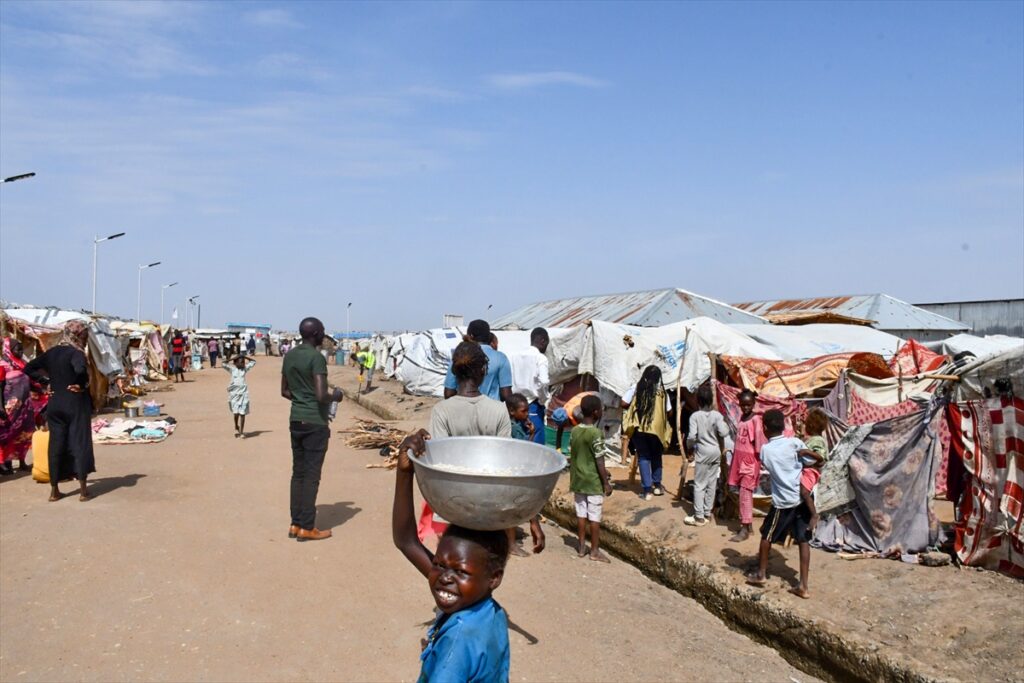
The world is failing to address the worst humanitarian crisis in recent times as Sudan marked this week the third anniversary of a brutal internal conflict between its rival security forces, says a top United Nation official.
“This grim and chastening anniversary marks another year when the world has failed to meet the test of Sudan,” UN Emergency Relief Coordinator Tom Fletcher said in a statement from Berlin, where the international community met on Wednesday, amid continuing efforts to end the war.
The deadly fighting that erupted on 15 April 2023 between the Sudanese Armed Forces (SAF) and former allies the Rapid Support Forces (RSF) has left nearly 34 million people – a staggering 65 per cent of the population – in urgent need of humanitarian support.
Some 14 million people have been displaced, with nine million seeking safety elsewhere in the country and 4.4 million crossing the border to countries such as Chad, Egypt and South Sudan.
Sudan and its people are now “at breaking point,” according to the UN refugee agency, the UNHCR.
Even though nearly four million people have begun returning to their communities, “they find broken water systems, destruction, and a lack of basic shelter and healthcare,” said Zoe Brennan of UN migration agency IOM, speaking to journalists in Geneva.
The crisis in Sudan “continues to deepen with no end in sight,” a senior official with the World Food Programme (WFP) said at the same briefing.
“We are two years into a famine in parts of the country, and this is simply unacceptable in this day and age,” said Ross Smith, WFP Director of Emergency Preparedness and Response.
“Millions of Sudanese are trapped in a daily struggle to secure food safety, basic dignity. Families have exhausted every coping mechanism. Parents are skipping meals so the children can eat—and children are going hungry.”
Famine has been confirmed in Darfur and the Kordofans, where fighting is heaviest, but the overall crisis in Sudan “is being dangerously compounded by the wider global instability and the recent escalation of conflict in the Middle East,” he said.
The Iran war has disrupted shipping routes which is driving up the costs of food, fuel and fertilizer, core commodities that Sudan imports and heavily relies on.
“Fuel prices have already increased by over 24 per cent on average. In some remote areas, much more than that. This will have a knock-on effect on all the prices of all staple goods and food commodities, pushing more people into hunger,” he warned.
“As we enter a fourth year of war in Sudan, it is important that we be clear about what this means for women and girls, because ultimately, this is a war on them,” said Anna Mutavati, Regional Director for East and Southern Africa, speaking from Berlin.
UN Women have issued a report which estimates that 12.7 million people – mainly women and girls – require support related to sexual and gender-based violence, up from 3.1 million in 2023.
Mutavati stated that “widespread killings, mass displacement, and most definingly the use of sexual violence…is embedded in the blueprint of Sudan’s war.”
The current conflict is between the Sudanese Armed Forces (SAF) and the Rapid Support Forces (RSF). The SAF is the regular fighting force of the country; whereas the RSF is a paramilitary force that was created by the government of the ousted President Omar Al-Bashir.
Khalid A Dahab, an expatriate Sudanese strategic communication consultant and political analyst based in Johannesburg, said The roots of the conflict could be traced to 2003. when two rebel groups in the western region of Darfur, composed mainly of non-Arab tribes, took up arms against the Khartoum-based government after complaining about marginalisation and unequal development.
The government responded by arming the Arab tribes in the region to fend off the rebellion. These tribal militias, acting under the supervision of the SAF, committed widespread atrocities against the civilians of the non-Arab tribes. They became known as the Janjaweed (devils on horseback). After the rebellion subsided a little, these militias were formalised and became known as the Border Guard. Later, Al-Bashir changed their name to the Rapid Support Forces (RSF) and gave them ranks and modern weapons and attached them to the SAF.
Dahab said Following the widespread demonstrations against the government, the SAF and the RSF jointly overthrew Al-Bashir in April 2019 and a transitional civilian administration was formed in a power sharing formula. This lasted until October 2021, when the SAF and the RSF colluded to overthrow the civilian government.
The power and wealth of the RSF and its leader Gen. Mohamed Hamdan Dagalo (Himedti) grew phenomenally during this time to the extent that the SAF and its Commander in Chief Gen. Al-Burhan felt threatened and tensions grew between the two generals. This exploded in open war between the SAF and RSF on 15th April 2023.
“Since the beginning of the conflict, it is estimated the 150,000 people including civilians have been killed. Around 15 million people (one third of the population) have been displaced, 4 million of them as refugees in neighbouring countries such as Egypt, Chad, Ethiopia, South Sudan, Central African Republic, Uganda while the rest are displaced internally.
“An estimated 25 million people are threatened with famine, many of them actually experiencing it. The basic infrastructure, such as power plants, water treatment plants, schools, hospitals, etc. were fully of partially destroyed, particularly in the capital Khartoum. This meant that basic health services, as well as basic education services were unavailable. In fact 19 million school going children have not returned to school since the beginning of the conflict. Homes were looted and/or destroyed,” Dahab said.
As with any conflict in the world, there are some external players who are involved directly or indirectly in this conflict. This is of course because of economic or political interests.
The Sudan has huge reserves of gold, which has proven to be the main economic reason why these external players are involved. Countries such as the United Arab Emirates, Egypt, Russia, Saudi Arabia, Turky, Qatar and others are involved because of their interest in the gold reserves.