
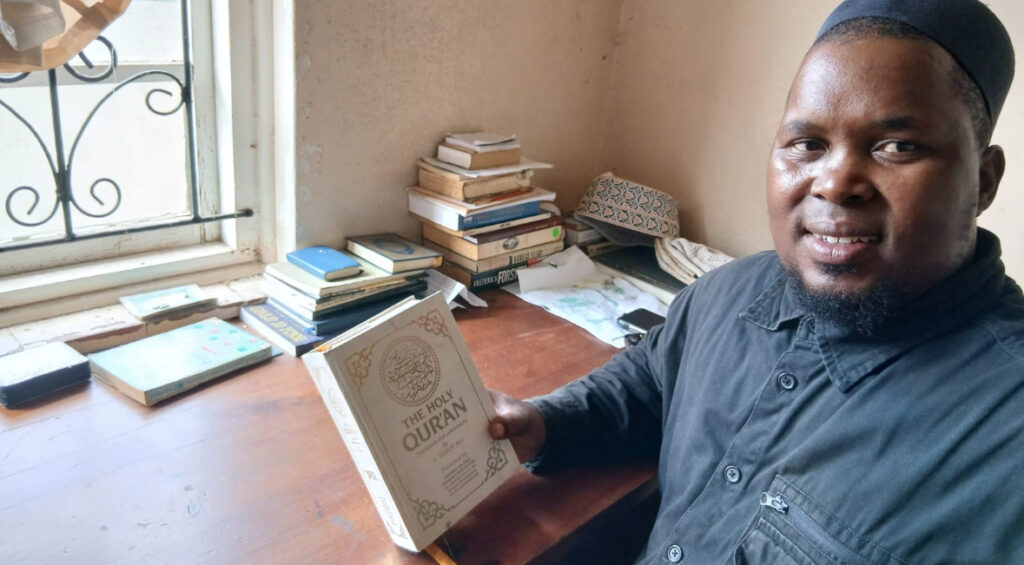
When Bongqi Mcane entered the reception area of Westville Prison he thought his life was over. A career criminal, he was sentenced to 15 years for armed robbery and hijacking. He thought his life was finished, but then he managed to get his hands on a Qur’ān, and that changed everything. Today Mawlānā Saeed Mcane…
Crime and unemployment is rife in Umlazi, as in most other townships. Our role models as youngsters were gangsters and thugs. Those involved in hijacking, theft and armed robbery.
While still at high school, many times I found myself under arrest, going to prison for three or four months for petty crimes. I didn’t see school as being of benefit to me and I thought it would just be better to be a full-time gangster or thug. So I left school.
One of my school friends who was worried about me persuaded me to visit his Mawlānā. I went with him and I listened to the Mawlānā explain the virtues of Islam, but I was not interested.
Instead of listening to the advice of the Mawlānā, I moved on to bigger crimes, like armed robberies.
In the late 1990s, I decided to leave my parent’s home and move in with some criminal friends.
By this time I was heavily involved in crime everyday. Around 2000, I was arrested along with some other guys for armed robbery and hijacking. We were sentenced to 15 years in prison.
Entering the gates of Westville, I thought my life was over.
During my time in reception I noticed there was one prisoner whom I thought was Muslim.
At that time I didn’t know it was a Qur’ān. Then I started thinking to myself that I’m going to be in prison for many years and I need to get rid of this part of me and make sense of my life.
So I asked him to let me see the book. He told me that in prison you don’t borrow people’s things, if you want things you buy them.

So I asked him again to borrow it, as I had no money. And he said no, not unless I gave him some money because prisoners are always looking for something to smoke or to buy drugs.
I had one nice jacket on me and so I asked him to trade the jacket for the book. And I thought the book was so thick it would take me years to complete. Only once he gave it to me did I come to know that it was the Qur’ān.
And I started reading and reading and reading. And I can tell you that on that night I hardly slept. The Qur’ān and the Bible have similar incidents, but the Qur’ān emphasises Tawḥīd – the Oneness of Allah Ta’ala.
The more time I spent with the Qur’ān, the deeper my interest became in Islam.
While I was reading the Qur’ān, my love for Islam just continued flourishing. I then learnt that religious leaders came to the prison often to speak to inmates.
I started attending the programs run by the Muslim Prison Board KZN. I benefitted hugely from the talks by Mawlānā Shabir Asmal, Sheikh Amir and the many ‘Ulamā they brought to talk to us.
The ‘Ulamā (spiritual leaders) that visited us every Monday inspired us to such an extent that I wanted to become like one of these Muftis.
It was some kind of freedom. Islam has Just principles. Allah Ta’ala says in the Qur’ān that “the most noble among you is the one who has taqwa.” What he is saying that the issue of race, status is not an issue.
Amongst human beings it can be but in the court of Allah Ta’alah, Allah only wants taqwa.
These Ulamā taught us if you obeyed Allah Ta’ala, you are dutiful to Allah Ta’ala, you are conscious of Allah Ta’alah at all times, no matter how dark your skin is, or how poor Allah Ta’alah can raise you and be pleased with you.
All this learning changed my approach to my prison term. Instead of feeling angry about my sentence, I came to accept that I had to serve time because I had hurt so many people and committed so many crimes. I just felt 15 years was nothing. I had committed so many sins for which I was not punished, so I accepted that I deserved my punishment. I made a lot of tawbah (sincere repentance) until my release after eight years inside.
Maulana Saeed Mcane was imprisoned in 2001, accepted Islam at the Westville Prison due to the efforts of the Muslim Prison Board in KZN. He was released on parole in 2008 and studied the Imāmat course at Madrāssah Taalim ud Deen in Isipingo Beach. Thereafter he began the ‘ālim course at madressah Miftaahul Falaah in Harding from 2009 to 2012.